Worldsensing’s Vibration Meter is a wireless sensor that automates data collection for continuous, long-term vibration monitoring. It features a triaxial accelerometer and an edge algorithm that responds to anomalies: it detects when thresholds for vibration-based parameters are exceeded.

Four operational modes

The Vibration Meter offers multiple operational modes to address a diverse range of vibration monitoring applications. Each mode is designed to extract key parameters for specific scenarios, enabling accurate assessment of structural behavior, ground response, and human comfort.

Configurable parameters

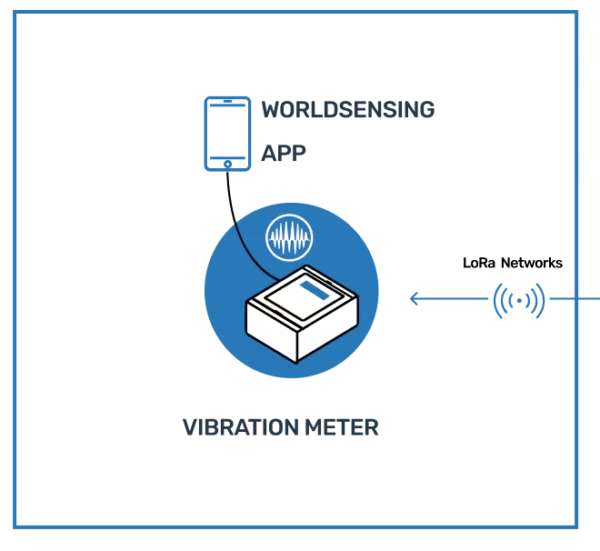
Different reporting periods, two configurable thresholds managing the reporting logics, and acquisition parameters can be configured using CMT or the Worldsensing App

Alert mode

Use the secondary threshold to have highly critical events reported automatically in a shorter reporting period

Raw data storage

Specific mode raw data (i.e. waveforms for PPV) are stored in the device’s internal memory for the relevant events. Downloadable via local connection or Bluetooth, via Worldsensing App

Main technical specifications

Sensor type
3-axis MEMS accelerometer
Operation modes
MTVV, PPV, PGA, PSA
Sampling rate
Configurable, derived from 4KHz signal
Noise
22.5 μg/√Hz for Vibration-IHP // 75 μg/√Hz for Vibration-IR
Original frequency band
DC - 1000 Hz
Power source
1 x 3.6 V D-size replaceable battery
Data transmission
LoRa radio communications (ISM sub GHz)
Operating temperature
-40º C to 80º C
Weather protection
IP68
System configuration
Locally via Worldsensing App or remotely using CMT Edge on single-net deployments and CMT Cloud on multi-net deployments

PPV-based operation mode specifications

Reported parameters
Timestamp, PPVX,Y,Z (mm/s), f X,Y,Z (Hz), T (ºC), PVS (mm/s), Duration
Range (velocity and frequency) - Vibration-IHP
0-30 mm/s - 1-100 Hz 0-60 mm/s - 1-100 Hz 0-120 mm/s - 1-100 Hz 0-50 mm/s - 1-250 Hz
Range (velocity and frequency) - Vibration-IR
0-120 mm/s - 1-250 Hz 0-200 mm/s - 1-250 Hz 0-200 mm/s - 1-315 Hz

MTVV-based operation mode specifications

Reported parameters
Timestamp, LAW-X,Y,Z (dBm), T (ºC), Duration
Acceleration range
±2 g
LAW range
<100 dB
Frequency weighting
Wm (ISO 2631-2)

PGA-based operation mode specifications

Reported parameters
Timestamp, PGAX,Y,Z (mg), f X,Y,Z (Hz), RMS vector (mg), T (ºC)
Raw acceleration range
±2 g
Internal acceleration resolution
3.9 µg
Output acceleration resolution
0.1 mg
Sampling rate
Configurable from: BAND 1: 62.5 Hz BAND 2: 125 Hz BAND 3: 250 Hz BAND 4: 500 Hz

PSA-based operation mode specifications

Reported paramaters
PGA (vector) (mg), f X,Y,Z (Hz) {1st to 5th}, RMS X,Y,Z (mg), T (ºC) , PGA timestamp
Raw acceleration range
±2 g
Internal acceleration resolution
3.9 µg
Sampling rate
Configurable from: BAND 1: 62.5 Hz BAND 2: 125 Hz BAND 3: 250 Hz BAND 4: 500 Hz
Output frequency resolution
BAND 1 = 0.02 Hz BAND 2 = 0.04 BAND 3 = 0.08 BAND 3 = 0.16

Battery life estimations

Reporting period
SF9
SF11
10 min
1.5 years
11 months
30 min
2 years
1.4 years
Show full table +

Vibration Meter Mounting Options

Surface mounting

Using the LS-ACC-IN15-HP plate recommended for both horizontal and vertical mounting. It can be fixed to the surface with anchor rods or glue. Includes a threaded hole available for installing a monitoring prism or a button head screw for precise levelling.

Horizontal surface mounting

Using the compact LS-ACC-IN-HPTM horizontal surface mounting plate. Designed to be glue to the surface for fast and robust fixing.

Horizontal surface mounting with double plate

Using a versatile double plate LS-ACC-IN15DP for horizontal surface mounting to avoid opening the casing for device installation. It can be fixed to the surface with glue. Includes a threaded hole available for installing a monitoring prism or a button head screw for precise levelling.

Applications

Explore the diverse applications of our wireless sensor, delivering precise vibration monitoring for reliable insights.

Vibrations

Vibration meters

Monitor the impact of vibrations created by industrial activities on people’s comfort with Worldsensing’s Vibration Meter, designed to operate in compliance with industry standards (ISO 2631-2).

Vibrations for building integrity

Vibration meters

Monitor the impact of industrial activities on surrounding infrastructure with Worldsensing’s Vibration Meter, designed to operate in compliance with industry standards for building integrity (DIN4150-3 and BS7385-2).

Vibration Meter Discovery Session

Take a deep dive into Worldsensing’s new wireless sensor, the Vibration Meter. Learn what makes the Vibration Meter the best alternative for cost-effective, long-term vibrations monitoring in construction and mining activities. We will be talking about its key features, operational modes available to comply with international and local regulations (ISO, DIN, BS) and performing a demonstration to see real data captured and processed by the device.

Watch the Vibration Meter Discovery Webinar

Frequently Asked Questions about the Vibration Meter

What is the vibration meter?

The Vibration Meter is a wireless sensor designed to measure vibration levels and detect vibration-based events. It features a tri-axial accelerometer and can detect threshold breaches for vibration-based parameters such as LAW/PPV and frequency.

How does Vibration Meter work?

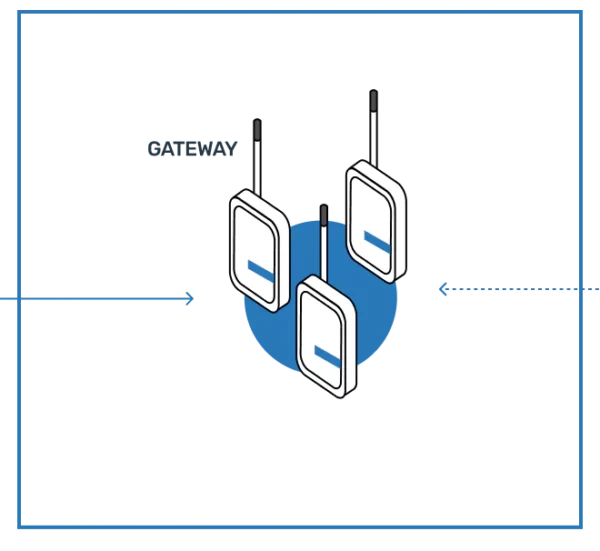
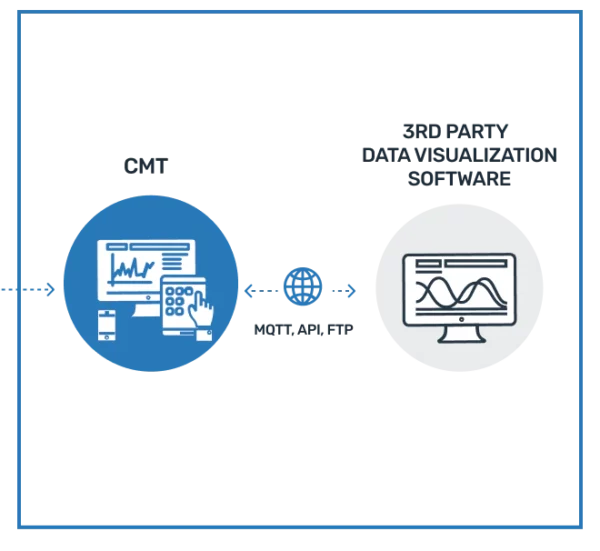
The Vibration Meter data sensor uses a 3-axis accelerometer to measure vibration changes. It transmits data via Worldsensing LoRa networks to a CMT Edge for local-access, single-network deployments. For multi-project, multi-network deployments, data can be transmitted via the internet from the gateway to CMT Cloud. Data can be sent to third party software from CMT using standard file transfer protocols: MQTT, REST API, FTP.

What is the maximum interval at which vibration data can be collected?

Devices can be configured at different reporting periods. The highest possible acquisition rate when using Worldsensing is one sample every 30 seconds, and the lowest is one sample every 24 hours.

What is the communication range for the data logger?

The radio range of any of Loadsensing devices varies depending on the environment. In open sight, the range can reach up to 15 km (9.3 mi), while in a city street it is up to 4 km (2.5 mi). When placed in a manhole in a city street, the range is up to 2 km (1.2 mi), and in a tunnel, it extends up to 4 km (2.5 mi).

Is this vibration meter in compliance to DIN 4150-3?

Yes, but not exclusively. We process the PPV and frequency parameters required by this specific standard, but these parameters and processing methods are applicable across a wide range of vibration standards that rely on similar indicators. Ultimately, the choice of a particular standard depends on the specific threshold levels used for comparison against the reported data.

Is it required to level the device during installation?

The device can be installed in any orientation, as MEMS sensors don't require specific corrections for different components. It automatically filters gravity effects, so leveling isn't needed, and performance remains unaffected by orientation.

However, data is always reported in the X, Y, and Z axes, with one axis ideally aligned vertically. Small misalignments will introduce minor crosstalk between channels, so while performance is still reliable, it’s recommended to level the sensor for optimal accuracy.

Is an MQTT license required to receive alert messages?

No, an MQTT license is not mandatory for receiving alert messages. Vibration Meter (VM) formats alert messages the same way as regular periodic data messages. The only difference is that alerts are triggered immediately when a vibration exceeds the configured threshold and are appended to previous events.

While MQTT is recommended for its benefits, integration through other methods will also provide access to the data in real time. This differs from other Worldsensing's Tiltmeter Event Detection, where response latency is much more critical.

Need more info or support? Talk to an expert

What they say about us

Discover how Worldsensing has made a positive impact, providing reliable solutions and exceptional support.

The adoption of Worldsensing IoT technology eliminates the need for cabling, reduces manual monitoring and allows significant savings up to 30% on the acquisition of materials and infrastructure and up to 40% on installation. Read success story

Leonardo Santana
Geotechnology Technical Leader, Tetra Tech

Worldsensing is very easy to use. I think the most important benefit is the wireless connection. This cable-free product is great for locations like tunneling sites. Read success story

Erdmann Jacobeit
Terra Vermessungen

Our customer needed to cover a landfill area of nearly two miles, and although they required solar-powered gateways, they needed data nodes that did not require constant maintenance. We selected the Worldsensing wireless data acquisition system due to its long-range radio, low power consumption, easy implementation and ability to read multiple types of sensors. Read success story

Edmund Kirby
General Manager and Co-Owner, Specto Technology

Worldsensing's IoT technology enables wireless, automated collection of sensor data in the mines for a safer and more work-efficient workplace. Read success story

Sudaryono Widodo
Founder and Director, Solusi Monitoring Indonesia

Using Worldsensing loggers and gateways has enabled us to increase the size and quality of our continuous ground monitoring network throughout the mine, while still remaining efficient about time and resources required.

Darren Neely
Senior Rock Mechanics Engineer, Vascoy Potash, Nutrien

The integration and reporting have been seamless and highly reliable since the start of our project. Trust in the structural health monitoring system lets the mine owner focus on the next steps of the mine construction. Read success story

Vincent Le Borgne
Mining R&D Manager, GEO-Instruments Canada (formerly GKM Consultants)

A great advantage of the Worldsensing system is the ability to change the reading frequency from a click of a finger without the need to go on site. So no need to access every logger to change it, it can all be done online.


Geomotion Australia

In spite of being installed in boreholes with steel covers, or behind the body of the dam with no line of sight to the gateway, the Worldsensing nodes are able to transmit data without the need for repeaters. Read success story

Ludek Novosad
Senior Instrumentation Engineer, Geomonitoring