
DATA COLLECTION
Get data from as early as the manufacturing process of pre-cast concrete segments at the preferred sampling rate

Ultra-robust 5-channel data logger designed to be embedded in pre-cast concrete. Connect vibrating wire instruments easily and securely such as strain gauges, pressure cells and any other vibrating wire sensor. Monitor structural health of your infrastructure from as early as the concrete segment manufacturing stage.
DOWNLOAD DATASHEETWorldsensing Edge Device
A wireless data logger designed to be embedded in concrete for remote monitoring of precast concrete infrastructure
Designed to be embedded directly into concrete since the tunnel segment manufacturing
Excellent communication range
Low maintenance, low-power solution
Key features of the VW-RCR

The interior of the VW-RCR is filled with an insulating resin that protects its electronic components from concrete particles during manufacturing and water exposure during its lifetime.

The data loggers components before pouring the insulating resin. The internal, whip antenna allows for wireless, remote communication.

The USB port of the VW-RCR is always accesible for configuration purposes.

The VW-RCR can be connected to five vibrating wire sensors, such as strain gauges or load cells.
HOW IT WORKS
Simplify your projects through remote, automated monitoring.
Get data from as early as the manufacturing process of pre-cast concrete segments at the preferred sampling rate

Manage all deployed devices, data and networks through Worldsensing's Connectivity Management Tool

Integrate third-party data visualization software for easy data analytics.
Datasheet - Vibrating wire
 Download PDF
DEVICE COMPATIBILITY
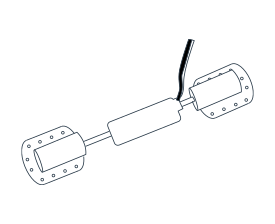
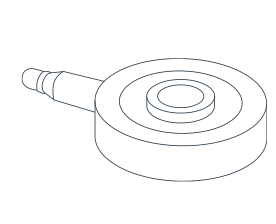
The VW-RCR is very well suited for tunnel construction when using tunnel boring machines (TBM) and concrete tunnel linings. Using data loggers that are embedded in tunnel linings during the manufacturing process significantly reduce the tasks and time needed to deploy standard monitoring solutions after the TBM has passed. Additionally, the VW-RCR provides critical information about the manufacturing process and the loads withstood by the concrete segments during construction and the structure’s lifetime.
There are two major components: first, the plastic case that is designed to withstand wet concrete, and second, the insulating resin that seals off the VW-RCR components. These two components are vital to the necessary robustness of the VW-RCR when it is being embedded in wet cement during concrete segment manufacturing.
The VW-RCR differs from Vibrating Wire 5-channel data logger in that the insulation provided in the VW-RCR makes it an IP68 rated device, which means it features a higher resistance to water and can be embedded in concrete. In addition, the communication ranges are achieved by an internal whip antenna, instead of a standard external antenna. Finally, the barometer is not functional, which the standar VW-5ch does.
During tunnel construction, the radio range is mainly affected by the interferences of the TBM itself. Once the TBM is removed and the tunnel is in completed, the radio range from a device to the nearest gateway can be up to 3 km in a straight line and 800 m in curved tunnels.
Once securely placed in the precast frame and before the cement is poured into the mold, the VW-RCR can be configured through the Worldsensing App via USB cable.
The resin used to insulate the VW-RCR has a gel-like consistency that can be cut and removed once it sets. The circuit board, connectors and batteries are this way accessible, even after the case is sealed with the resin.
Once the VW-RCR is connected to the corresponding sensors, the gel is poured over the circuit board, allowing it be fully covered. The resin sets in 24 hours for a full insulation of the device against water and wet cement particles that could enter while wet.
For configuration purposes, the USB port can be accessed by opening the lid of the VW-RCR. If the device is already embedded, the concrete layer covering the device lid must be chiseled out in order to access the device lid.
Both CMT Edge and Cloud can be deployed for the data management of the VW-RCR

The ideal complement to Worldsensing's long-range low-power solutions portfolio, geared towards customers who need broadband sensor connectivity for high-data rate, high-power, or high-speed industrial project scenarios.
View Thread X3
Get peace of mind by extending device warranty for up to 5 years
View Extended Warranty
The Worldsensing App can now be used to configure ALL the Worldsensing edge devices. It facilitates quick and easy device configuration without the need for a laptop onsite. Leverage new stand-alone configuration options.
View Worldsensing AppOur newsletter will keep you up to date on everything related to Worldsensing, civil infrastructure resilience and IoT remote monitoring.
Please select one or all industries you are interested in.

